The July 2017 Announcement and What It Promised
On July 28, 2017, then-FDA Commissioner Scott Gottlieb and then-Center for Tobacco Products Director Mitch Zeller published a statement outlining what they called a "comprehensive plan for tobacco and nicotine regulation." The centerpiece was audacious: a proposed product standard that would require cigarettes sold in the United States to contain nicotine at levels too low to sustain addiction. The agency described its authority to set such a standard as flowing directly from Section 907 of the Family Smoking Prevention and Tobacco Control Act of 2009, which permits FDA to establish tobacco product standards where doing so would be appropriate for the protection of public health.
The announcement made no immediate legal difference — no docket number was yet attached, no comment period opened. What it did was signal an administrative intention of a scope the agency had never previously attempted. Reducing nicotine to a "minimally addictive or non-addictive level" would apply to all combusted cigarettes. The phrase "minimally addictive or non-addictive level" would eventually crystallize into a specific number.
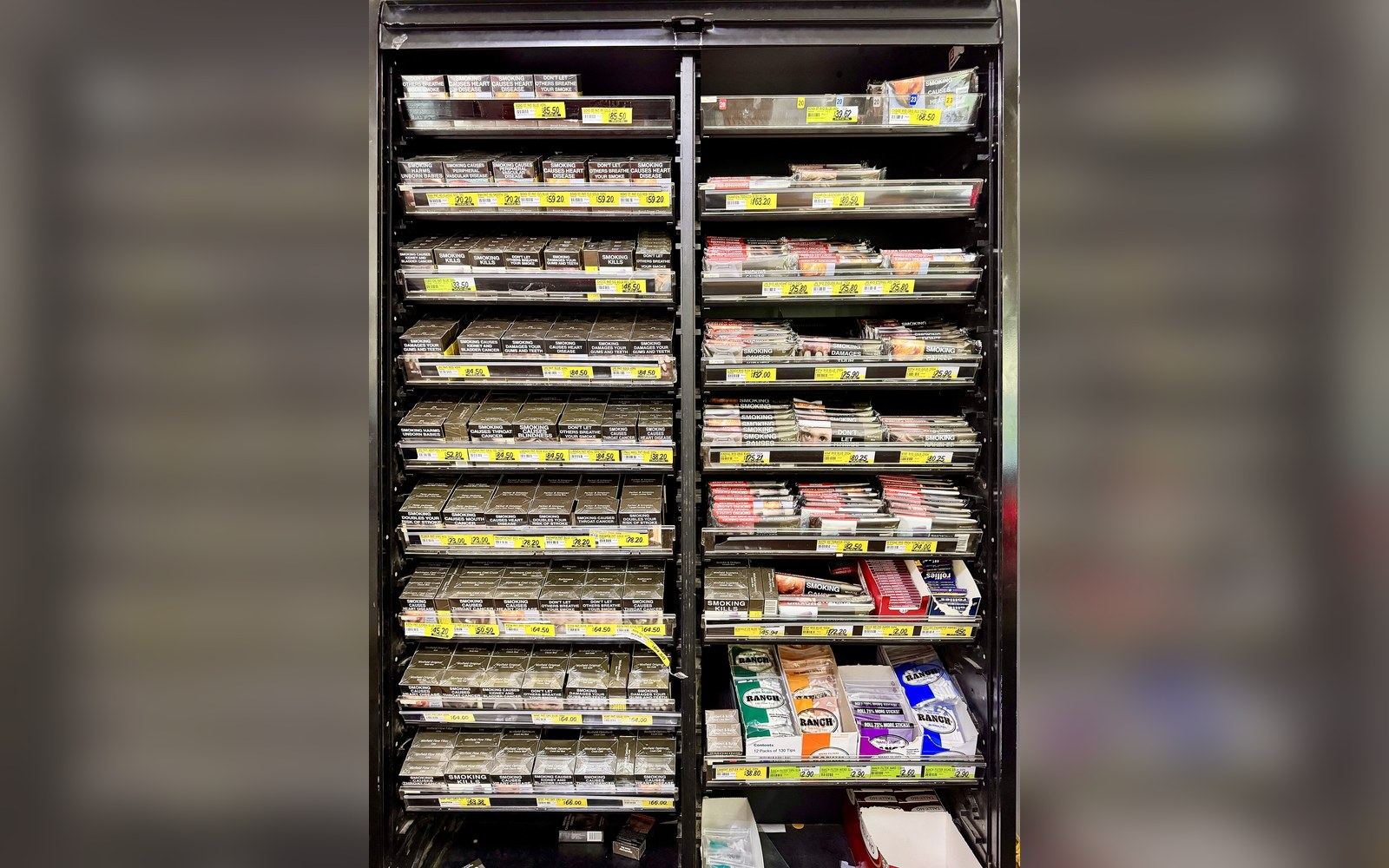
Pantone 448C, one typeface, no brand imagery — the pack as the 2011 Act specifies it.
Photo: Wikimedia Commons
Docket 2017-N-6189 and the 0.7 mg/g Threshold
The formal advance notice of proposed rulemaking opened under docket FDA-2017-N-6189 in March 2018, inviting public comment on what a nicotine product standard should look like, how compliance would be measured, and what economic effects the rule might carry. Thousands of comments arrived from public-health researchers, tobacco companies, retailers, and individual smokers.
What followed was years of silence in the Federal Register on this particular docket, punctuated by the release of a proposed rule in January 2025. That notice specified a maximum nicotine yield of 0.7 milligrams per gram of tobacco — a figure derived partly from research showing that cigarettes at or below that level do not sustain dependence in the way that standard commercial cigarettes do. The proposed rule, published under the same docket lineage, opened a public comment period and invited responses on the technical standard, the implementation timeline, and the evidence base.
The 0.7 mg/g figure is not arbitrary. Studies conducted at institutions including the University of California, San Francisco — whose tobacco-documents archive had already established the industry's long internal knowledge of nicotine's addictive properties — had informed the broader scientific record on which the FDA drew. Standard commercial cigarettes deliver roughly 10 to 15 mg of nicotine per gram of tobacco, making the proposed ceiling a reduction of more than ninety percent.
Rulemaking milestones
- July 28, 2017Gottlieb/Zeller announcement of comprehensive nicotine regulation plan
- March 2018Advance notice of proposed rulemaking opens; docket FDA-2017-N-6189
- January 2025Proposed rule published; 0.7 mg/g maximum nicotine yield specified
- Status as of publicationComment period open; no final rule issued
Whether the January 2025 notice will survive the change in administration and complete its way through the formal rulemaking process — a final rule, a possible legal challenge, an effective date — remained an open question as this article was prepared.
Eight Years of Parallel Motion
The nicotine product standard's slow trajectory becomes legible only when read alongside the other tobacco rules moving through the same agency during the same window. Some proceeded faster. Some stalled harder.
The graphic health-warning requirement, mandated by Congress in 2009, was proposed in 2011, then blocked by the U.S. Court of Appeals for the D.C. Circuit on First Amendment grounds. A revised set of eleven graphic warnings was proposed in 2019 under docket FDA-2019-N-1094 and finalized in March 2020. Industry litigation followed, and the warnings were still being contested in federal courts years later — a reminder that a final rule is not the same as an implemented one.
Pantone 448C, one typeface, no brand imagery — the pack as the 2011 Act specifies it.
Photo: Wikimedia Commons
Tobacco 21 — the minimum-purchase-age increase from eighteen to twenty-one — bypassed rulemaking entirely. Congress inserted the change into the Further Consolidated Appropriations Act of 2020 , signed into law in December 2019, making it immediately effective federal law without a comment period or agency docket. The FDA issued guidance on enforcement, but the legal change itself required no product standard proceeding. Speed, in that instance, came from legislative rather than regulatory action.
The menthol characterising-flavour standard — a separate proposed rule targeting the single most consequential exemption in the 2009 Act's flavour ban — was issued in April 2022 under docket FDA-2021-N-1349. It drew more than a million public comments, a volume that itself indicated the rule's political sensitivity. Then, in 2024, the Biden administration shelved the menthol proposal before it reached a final rule, citing the need for additional review. That decision followed sustained opposition from some civil-rights organisations who argued that aggressive enforcement could disproportionately affect Black smokers, while public-health groups argued the opposite. The menthol proposal's withdrawal illustrated exactly the kind of political force that can arrest a rulemaking even after it clears the comment stage.
The nicotine product standard has not yet reached that stage.
Parallel rules: speed comparison
- Tobacco 21Enacted by Congress December 2019; effective immediately; no rulemaking required
- Graphic warning labelsRequired 2009; first proposal blocked in court 2012; finalized March 2020; still litigated
- Menthol flavour standardProposed April 2022 (docket FDA-2021-N-1349); withdrawn 2024 before final rule
- Nicotine product standardAnnounced July 2017; proposed rule January 2025; not yet final
Why the Timeline Matters
Federal rulemaking under the Administrative Procedure Act requires notice, comment, agency response to significant comments, and then a final rule. Courts reviewing final rules apply the Chevron framework — now itself unsettled after the Supreme Court's 2024 decision in Loper Bright Enterprises v. Raimondo — to assess whether an agency's interpretation of its statute was reasonable. A nicotine product standard, if finalized, would almost certainly face immediate legal challenge from tobacco manufacturers arguing that the standard exceeds the agency's statutory authority, constitutes an effective ban on cigarettes in violation of the 2009 Act's explicit prohibition on outright bans, or was procedurally inadequate.
The 2009 Act's ban-on-banning provision — Section 907(d)(3), which prohibits FDA from requiring the reduction of nicotine yields to zero — was deliberately drafted to foreclose a prohibition route. Supporters of the nicotine standard argue that 0.7 mg/g is not zero and that the statute expressly authorizes a product standard reducing nicotine to a level insufficient to create or sustain addiction. The statutory argument is not frivolous on either side, which is why litigation, if a rule is ever finalized, would likely be substantial.
In the eight years since the July 2017 announcement, the FDA has changed commissioners multiple times. Gottlieb departed in 2019. Janet Woodcock served as acting commissioner. Robert Califf returned as commissioner in 2022 after a prior term. Each transition carries the possibility that the priority ordering of pending rulemakings shifts. The nicotine product standard has survived those transitions as a live docket, but "live" and "advancing" are different conditions.
As of the January 2025 Federal Register notice, the proposed rule existed as exactly that — a proposal. Comments were invited. The rulemaking clock, measured from July 28, 2017, had passed seven and a half years. The standard itself was still not final.