The ad that opened the industry's decades-long argument about science
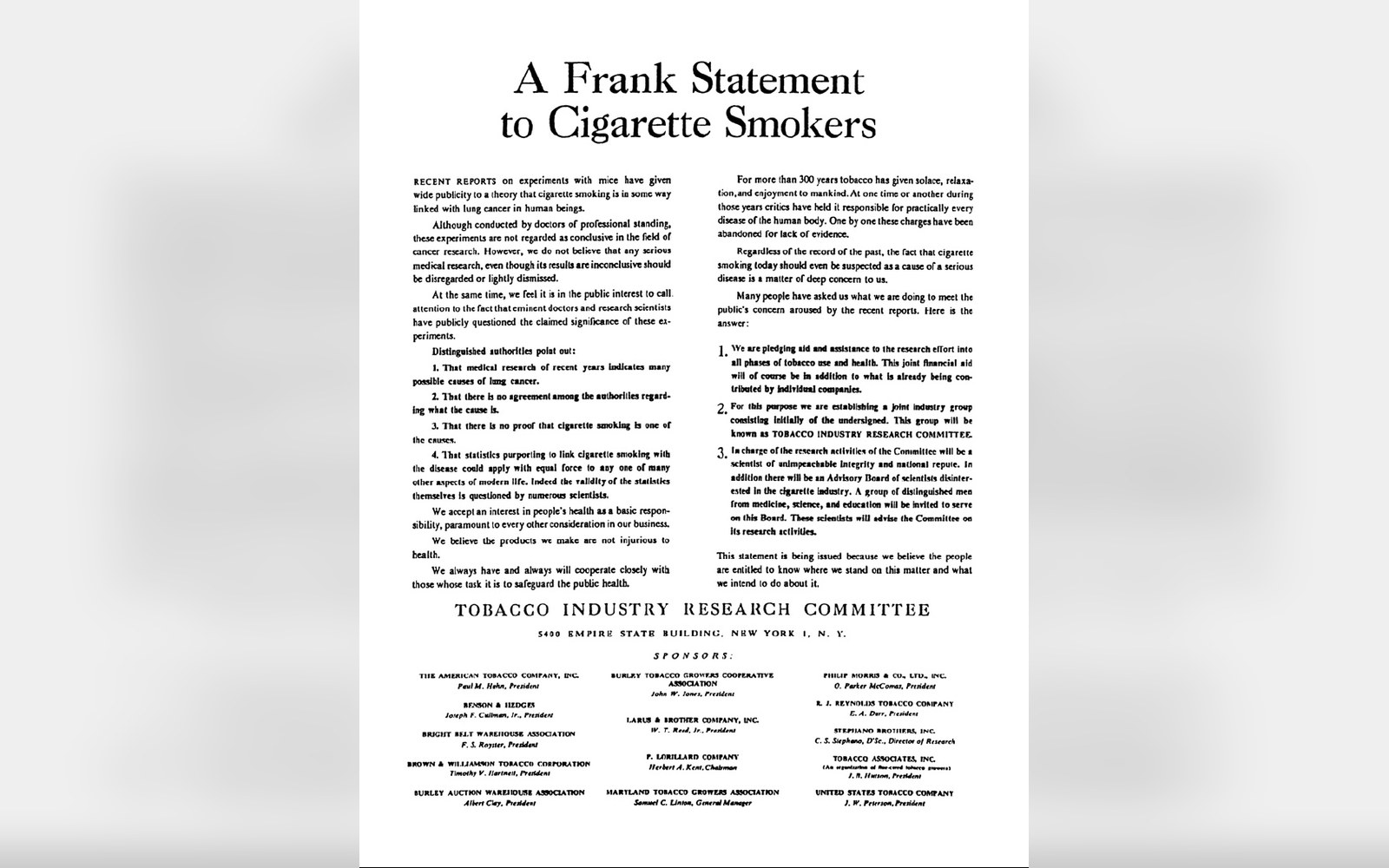
On January 4, 1954, readers of newspapers across the United States turned a page and encountered a full-page advertisement unlike most they had seen. It carried no product to sell, no price to quote, no brand imagery. It was addressed directly to them — "A Frank Statement to Cigarette Smokers" — and it bore, at the bottom, the signatures of fourteen tobacco companies and their trade associations. The document ran in approximately 400 American newspapers simultaneously, a coordinated placement that cost the industry a substantial sum and reached, by design, a broad cross-section of the country on a single day.
The occasion for this unusual document was accumulating scientific pressure. Epidemiological studies published in 1950 by Ernst Wynder and Evarts Graham in the Journal of the American Medical Association, and by Richard Doll and Austin Bradford Hill in the British Medical Journal, had linked cigarette smoking to lung cancer. By 1953, laboratory work by Wynder and others had demonstrated that painting cigarette tar on the skin of mice produced tumors. The popular press had taken notice; Reader's Digest ran a condensed account. Cigarette sales had begun to soften. The industry needed a public posture, and the Frank Statement was that posture.

Campaign material survives as paper in boxes; the litigation record survives as scans.
Photo: cottonbro studio / Pexels
What the document claimed, sentence by sentence
The Statement opened by acknowledging the studies and the public concern they had generated. It then offered four substantive propositions: that the evidence against cigarettes was not conclusive; that eminent doctors and research scientists had questioned the cause-and-effect interpretation of the statistical findings; that the industry took the public's health as a paramount concern; and that, as proof of that concern, the companies were announcing the formation of the Tobacco Industry Research Committee (TIRC), which would fund independent scientific inquiry into the questions raised.
Each proposition carried rhetorical weight precisely because it was framed as concern rather than denial. The Statement did not say the studies were wrong; it said the question was open. It did not say the TIRC would vindicate cigarettes; it said the committee would seek the truth wherever it led. The language was designed to be cited, to appear in news coverage as evidence of corporate responsibility, and to pre-empt regulatory action by presenting voluntary industry science as the appropriate mechanism for resolving any remaining uncertainty.
The fourteen signatories included the dominant producers of the period. Philip Morris, R.J. Reynolds Tobacco Company, American Tobacco, Brown & Williamson Tobacco Corporation, Lorillard, and Liggett & Myers were among the companies whose names appeared at the foot of the advertisement. The signatory list also included trade bodies. The breadth of the signatures was itself a message: this was not one company managing a local reputational problem but a coordinated position of an entire industry.
Chronology
- January 4, 1954Frank Statement published in approximately 400 U.S. newspapers
- 1954Tobacco Industry Research Committee (TIRC) formally established, funded by signatory companies
- 1964TIRC renamed the Council for Tobacco Research; first Surgeon General's report published
- April 1994Seven tobacco CEOs testify before the House Subcommittee on Health and the Environment
- 1998Master Settlement Agreement signed; the Council for Tobacco Research is dissolved under its terms
- 1999U.S. Department of Justice files civil RICO case against the tobacco companies
- August 2006Judge Gladys Kessler issues findings of fact in United States v. Philip Morris; Frank Statement cited as opening act of fraud conspiracy
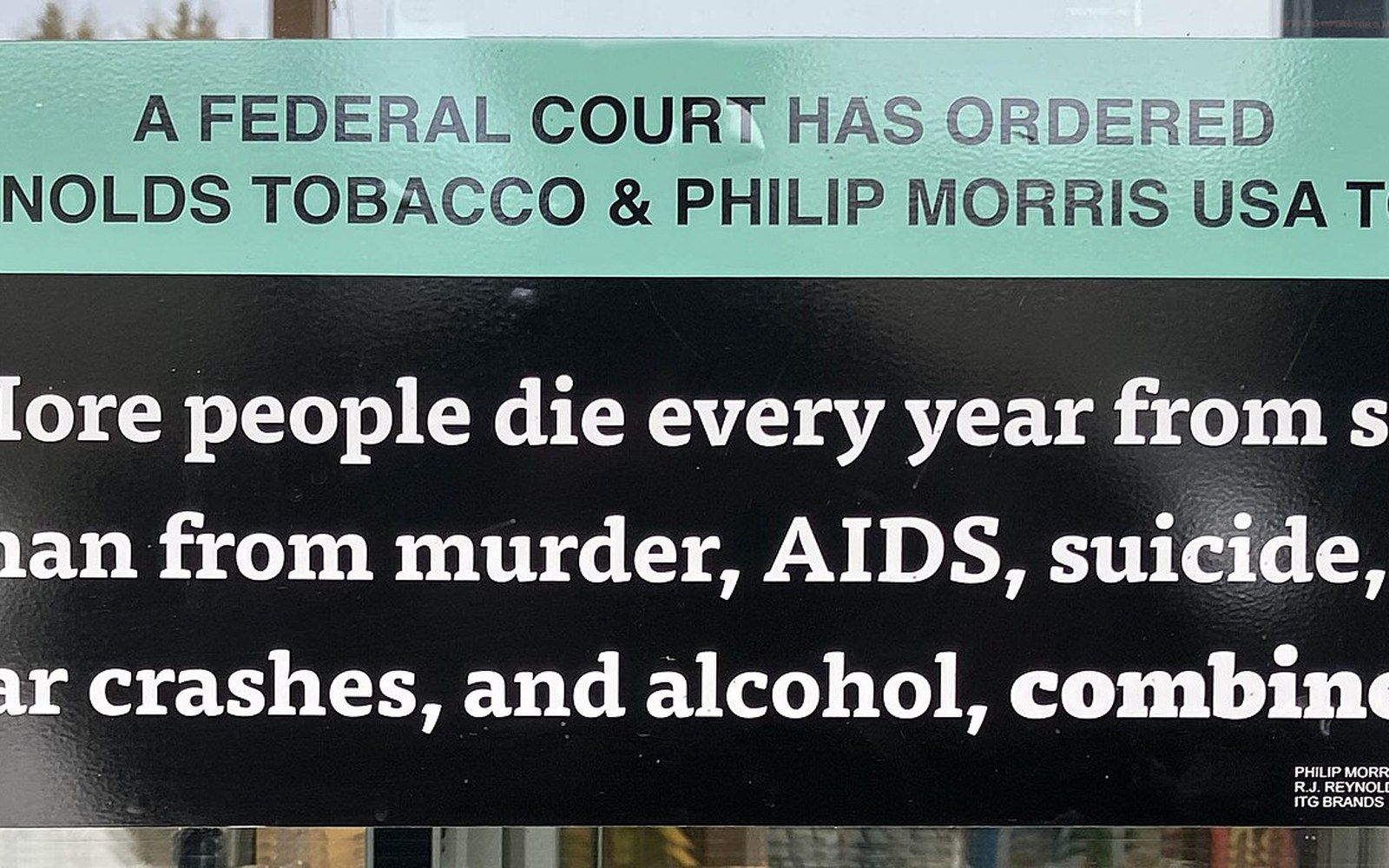
- 2017Court-ordered corrective statements begin publication
The Tobacco Industry Research Committee: independence, examined
The TIRC, announced in the Frank Statement as the concrete evidence of the industry's good faith, was funded entirely by tobacco companies. Its scientific director was C. C. Little, a geneticist whose views on the cause-and-effect question aligned with the industry's preferred framing. The committee's formal structure placed it at a remove from individual companies, which allowed the industry to describe its work as independent; its funding mechanism ensured it remained under industry control. Internal documents from the TIRC and from the companies that funded it — now held in the UCSF Truth Tobacco Industry Documents archive — show extensive communication between the committee and company lawyers about research priorities and public statements. The TIRC was renamed the Council for Tobacco Research in 1964, the year of the first Surgeon General's report on smoking and health, and it continued operations until it was dissolved under the terms of the 1998 Master Settlement Agreement.
What subsequent rulings made of the Frank Statement
Judge Gladys Kessler's 2006 judgment in United States v. Philip Morris — the civil RICO case brought by the U.S. Department of Justice — returned to the Frank Statement explicitly. Kessler found that the Statement represented the beginning of a decades-long conspiracy to deceive the American public about the health effects of smoking and the addictive properties of nicotine. In her findings of fact, the court identified the Frank Statement as the opening act of a coordinated campaign of fraud that the companies maintained from 1953 through the time of trial. The RICO statute, 18 U.S.C. § 1962, provided the legal framework for treating what had begun as a public-relations advertisement as evidence of an ongoing criminal enterprise.
The corrective statements ordered by the court and published from 2017 onward — on television, in newspapers, and on cigarette packaging — are, in a structural sense, the industry's compelled answer to the Frank Statement. Where the 1954 document said the science was inconclusive, the corrective statements, written by the court and published under the companies' names, said the companies had deliberately misled the public and that their cigarettes were addictive and lethal. The symmetry is not accidental; Kessler's remedy was designed to use the same channels of mass communication, paid for by the same companies, to reach the same public.

The closed gantry is a display rule, not a stock problem: several jurisdictions require the shutter.
Photo: Nicolás Rueda / Pexels
A document that rewrote what came after it
The Frank Statement's significance in the tobacco-control record is not that it was effective advertising — though it was — but that it set the terms of debate for the next four decades. Every congressional hearing at which industry executives testified that the science was unresolved, every regulatory proposal that the industry contested on the ground that more research was needed, and every litigation defense that questioned causation drew on the posture the Frank Statement established. When seven chief executives of tobacco companies appeared before the U.S. House Subcommittee on Health and the Environment in April 1994 and gave their now-famous testimony about addiction and nicotine, they were working within a rhetorical tradition the Frank Statement had inaugurated forty years earlier.
The document also established the template that the World Health Organization's Framework Convention on Tobacco Control, adopted in 2003, was partly designed to counteract: the use of industry-funded research bodies, presented as independent, to manufacture the appearance of ongoing scientific uncertainty. Article 5.3 of the FCTC, which requires signatory governments to protect public-health policy from commercial and other vested interests of the tobacco industry, names exactly this mechanism without naming 1954.
The newspaper that ran the advertisement on January 4 moved on to the next day's edition. The document it carried has been cited in federal court, incorporated into international treaty commentary, and placed at the center of the largest civil fraud ruling in American legal history.