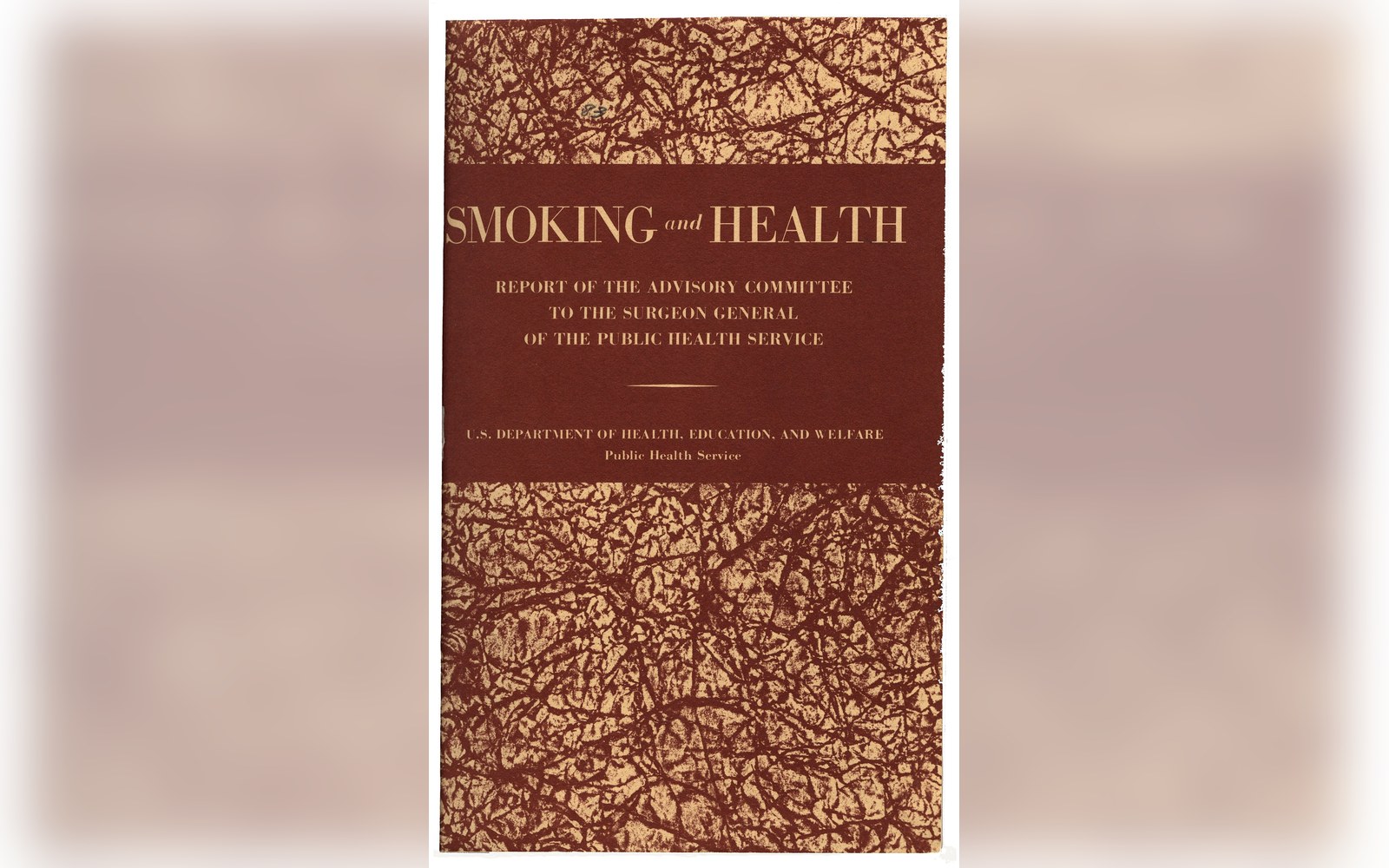
A Series Begins With a Single Finding
On January 11, 1964, Surgeon General Luther Terry convened a Saturday press conference — deliberately scheduled so that financial markets would be closed before the news broke — and released Smoking and Health: Report of the Advisory Committee to the Surgeon General. The 387-page document concluded that cigarette smoking was a cause of lung cancer in men and a probable cause in women, and a cause of chronic bronchitis. Its authority derived partly from methodology: an advisory committee of ten scientists, balanced to include researchers with no prior public position on smoking , reviewed more than 7,000 articles from the scientific literature.
That report was not conceived as the first in a series. It became one. The Federal Cigarette Labeling and Advertising Act of 1965, as later amended, required the Surgeon General to report periodically to Congress on the health consequences of smoking, and the resulting sequence of reports now constitutes one of the most sustained official scientific records in U.S. public-health history.

Pantone 448C, one typeface, no brand imagery — the pack as the 2011 Act specifies it.
Photo: Cigarettes plain packaging in Australia · Wikimedia Commons
What Each Major Report Added
The series did not repeat itself. Each subsequent report staked out territory the 1964 document had not addressed, or updated findings with a decade's additional evidence.
The 1979 report — the fifteenth anniversary edition, released under Surgeon General Julius Richmond — was the first to address cancer sites beyond the lung, and it introduced detailed examination of cardiovascular disease and chronic obstructive pulmonary disease as smoking-related conditions. By 1982 the series had turned to cancer comprehensively, and by 1983 it had addressed cardiovascular disease as a discrete volume.
The 1986 report, released by C. Everett Koop, was the turning point on secondhand smoke. The Health Consequences of Involuntary Smoking concluded that the non-smoker exposed to environmental tobacco smoke faced measurable excess risk of lung cancer — a finding that directly supported arguments for smoke-free workplace legislation at both state and federal levels. The report's conclusion that there is no safe level of exposure to secondhand smoke became a standard citation in subsequent regulatory proceedings.
Key reports in the series
- 1964Smoking and Health: cause of lung cancer established; first report
- 1986Involuntary Smoking: secondhand smoke causes lung cancer in non-smokers
- 1988Nicotine Addiction: nicotine classified as addictive drug
- 1994Preventing Tobacco Use Among Young People: initiation before age 18 documented
- 2004Comprehensive review; $150 billion annual economic cost estimated; additional cancers added
- 201450 Years of Progress; 20 million U.S. deaths since 1964 attributed to smoking; eight new diseases added
By 1988, the series had reached addiction. Koop's report that year, The Health Consequences of Smoking: Nicotine Addiction, classified nicotine as an addictive drug meeting the same criteria applied to heroin and cocaine — a comparison that tobacco companies would spend years contesting in litigation and before Congress, including at the April 1994 hearing where seven chief executives testified under oath.
The 1994 report, issued under Surgeon General Joycelyn Elders, focused on youth. Preventing Tobacco Use Among Young People documented that virtually all adult smokers had initiated before the age of 18 and that addiction was typically established in adolescence. It became a foundational text for the FDA's mid-1990s effort, led by David Kessler, to assert jurisdiction over tobacco as a nicotine-delivery device.
The 2004 report, The Health Consequences of Smoking: A Report of the Surgeon General, functioned as a comprehensive scientific review, identifying additional causally linked cancers — including cervical, kidney, pancreatic, and stomach cancer — and estimating the economic costs of smoking-attributable illness at more than $150 billion annually, a figure drawn from the report's own analysis of direct medical expenditures and lost productivity.
The Count Through 2024
The Office of the Surgeon General has published 34 reports on tobacco and health through 2024 , covering subject areas that include: women and smoking (1980, 2001), minority populations (1998), oral health, pipe and cigar use, the global dimensions of the epidemic, and e-cigarettes. The 2014 report, The Health Consequences of Smoking — 50 Years of Progress, marked the half-century point by adding eight diseases — including diabetes and colorectal cancer — to the list of conditions causally attributable to smoking, and concluded that smoking had caused approximately 20 million deaths in the United States since 1964.
The series is not a single argument advanced once. It is an accumulating official record — each volume a dated, numbered, attributed entry in a document sequence that now spans more than six decades of signed congressional reporting.